
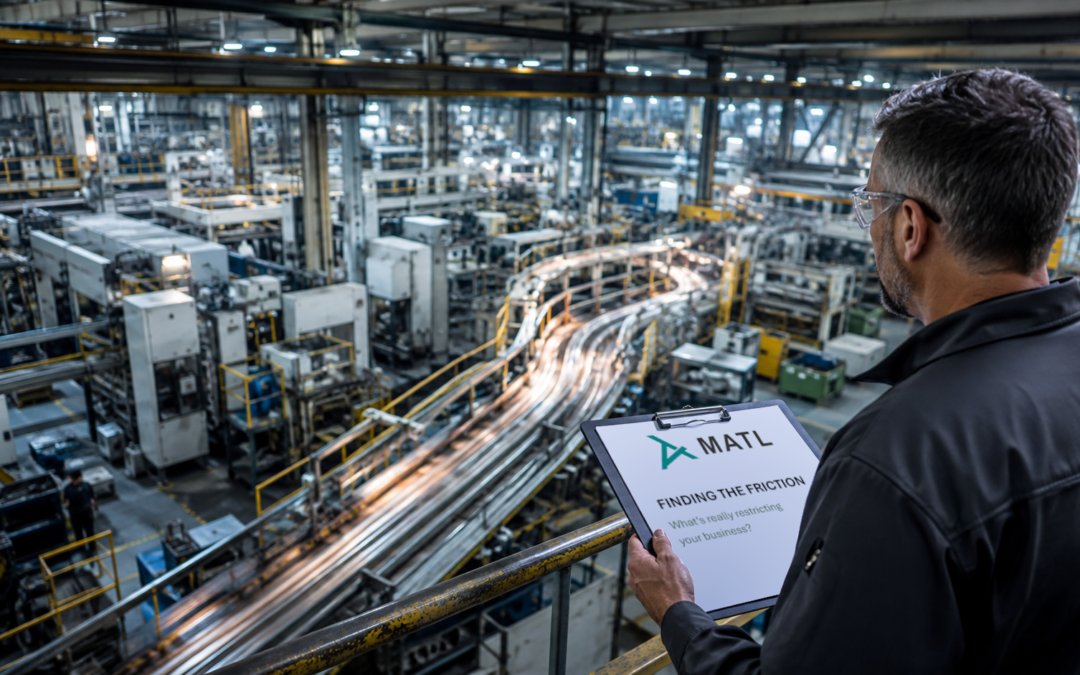
A series about discovering what is really getting in the way of business performance
Most business owners know when something isn’t working as well as it should.
Production takes longer than expected. Decisions seem to get delayed. Problems keep coming back. People are busy, but the business doesn’t appear to be moving forward at the rate it should.
The usual response is to look for something that needs fixing.
Perhaps the process needs changing or maybe new equipment is required. Perhaps another person needs to be recruited, or someone needs more training.
Sometimes that is exactly the answer.
But before deciding what needs to be fixed, there is another question worth asking.
“What is actually restricting performance?”
Because a business isn’t necessarily broken simply because it isn’t performing as well as it could.
It may be restricted.
A business is a system
That probably won’t come as a surprise to anyone working in manufacturing or engineering.
A business consists of systems that need to work together. Materials flow through processes. Information moves between people and departments. Decisions need to be made. Responsibility has to pass to the right people at the right time.
When everything is flowing properly, the business can operate efficiently.
When something restricts that flow, friction develops.
That restriction might be obvious. A piece of equipment may not have enough capacity. A process may be inefficient. Information may be missing when it is needed.
But some restrictions are much harder to see:
People have developed workarounds that hide the problem.
A decision is waiting for someone who is already overwhelmed.
Nobody is entirely sure who is responsible for something.
An employee knows that a process isn’t working properly but doesn’t feel able to challenge it.
The business continues to operate, but it is carrying friction. And over time, that friction can become accepted as normal.
The problem you see isn’t always the cause
This is something I have spent much of my working life investigating.
When you are trying to solve an engineering problem, dealing with the symptom isn’t necessarily the same as solving the problem.
If something repeatedly fails, you need to understand why, otherwise, you may simply keep fixing the same thing.
Businesses can be very similar.
You might have a recurring production delay and assume that the problem is with the production process. But perhaps the real cause is that information arrives too late.
You might think that a manager isn’t making decisions quickly enough, when the real problem is that they don’t have clear authority.
You may see poor communication between departments, but the underlying issue could be conflict, mistrust or a reluctance to challenge somebody.
The visible problem is real, but it may only be where the restriction finally becomes visible.
Operational systems and human systems
This is where things become more interesting.
Businesses are not made entirely of processes, machines and procedures.
They are operated by people.
People make decisions. They communicate information. They interpret instructions. They respond to pressure and change. They bring their experience, confidence, assumptions and behaviours into the workplace.
That means the human side of the business can sometimes create just as much friction as the operational side.
A poorly designed process can restrict performance; so can unclear leadership.
A machine can become a bottleneck; so can a business owner through whom every important decision has to pass.
Poor communication can delay a project; so can two people who have stopped speaking openly to each other.
These aren’t necessarily separate problems.
They are different parts of the same system.
Don’t start with the solution
One of the easiest mistakes to make when a business is under pressure is to decide what the solution is before properly understanding the problem.
“We need better communication.”
“We need to delegate.”
“We need more people.”
“We need new software.”
“We need to improve culture.”
Perhaps.
But why?
What is actually happening that makes those things necessary?
If you don’t understand the restriction, there is a risk that you spend time and money improving something that wasn’t causing the problem in the first place.
That is why I believe the starting point should be investigation.
Where is performance being restricted?
Where are decisions getting stuck?
Where is information failing to flow?
What problems have people learned to work around?
Where has dependency developed?
And what happens when the people within the system come under pressure?
Only when you begin answering those questions can you decide what needs to change.
Finding the friction
That is the thinking behind this series of articles.
Over the coming articles, I’ll be looking at some of the different places where friction can develop within a business.
Some of the problems are obvious.
Others have become so familiar that nobody notices them anymore.
Some are caused by processes and systems.
Others are created by leadership and decision-making.
And some involve the very human behaviours that can affect how people perform under pressure.
The important thing is not to assume where the problem lies.
You have to look.
You have to investigate.
And you have to understand what is actually causing the restriction.
Because once you can see the friction, you can start deciding how to remove it.
And sometimes the business doesn’t need to be transformed. It simply needs the restrictions removed so that the people, systems and resources it already has can work together more effectively.
So, where is the friction in your business?
And perhaps more importantly:
Do you know what is causing it?